The Stock Rahul Almost Bought
Rahul was standing near the office tea machine when he heard it.
“Just buy quality stocks,” his colleague said. “Don’t overthink. Good companies always create wealth.”
The sentence sounded wise.
Rahul had recently opened his demat account. He had watched a few videos, saved a few posts, and started noticing stock names everywhere. At lunch. On YouTube. In WhatsApp groups. Even in family conversations where someone always seemed to know “one solid company for the long term.”
That evening, he opened his trading app.
The stock his colleague mentioned was famous. The company’s products were everywhere. The chart looked impressive. The internet called it a “quality compounder.”
Rahul hovered over the buy button.
Then his father, who was sitting beside him with a cup of tea, asked a simple question.
“What does the company actually do?”
Rahul smiled. “It’s a good company.”
His father waited.
“No, I mean how does it make money?”
Rahul looked back at the screen.
For the first time that evening, the stock price stopped looking like an answer and started looking like a question.
A quality stock is not something you believe in because others sound confident. It is something you learn to verify.
That night, Rahul did not buy the stock.
Instead, he opened a notebook and wrote one line:
“What makes a company quality?”
The journey started there.
Table of Contents
Educational Note: This article is designed to help you understand how investors evaluate businesses. It is not a recommendation to buy or sell any stock. Always do your own research before investing.
The First Door: Understanding the Business
The next day, Rahul met his mentor, Meera, a senior colleague who had been investing for years.
He expected her to talk about ratios.
ROE. ROCE. P/E. Debt. Cash flow.
Instead, she asked him to describe the company in one sentence.
Rahul tried.
“It is a strong brand.”
“That is not a business model,” Meera said gently. “That is your impression of the company.”
Rahul frowned.
She continued, “Imagine you are buying a small shop in your neighbourhood. Before checking profit, wouldn’t you ask what it sells, who buys from it, why customers return, and whether another shop can easily take those customers away?”
That made sense.
A stock was not just a number moving on a screen. It was ownership in a business.
So Rahul wrote his first set of questions:
- What does the company sell?
- Who are its customers?
- Why do customers choose it?
- Can competitors copy it easily?
- Does it depend on one product, one customer, one regulation, or one commodity cycle?
- Can I explain the business to a friend without using fancy words?
Meera pointed to the last question.
“If you cannot explain the business simply, you probably do not understand the stock yet.”
That line stayed with him.
The first quality filter is not financial. It is clarity. If the business is unclear to you, your confidence is borrowed.
But Rahul quickly discovered something else. A business can sound wonderful in a story. The next question is whether the numbers agree.
The Five-Year Test Rahul Did Not Know He Needed
Rahul returned the next evening with excitement.
“I checked the latest results,” he told Meera. “Revenue is up. Profit is up. Looks strong.”
Meera nodded. “Good. Now check the last ten years.”
“Ten years?”
“Yes. A company can look impressive for one year. Quality needs time as a witness.”
Rahul opened the financial history.
The latest year looked excellent.
But five years ago, profit had fallen sharply. Three years ago, revenue had barely grown. One year had a large jump because of an unusual gain. Margins moved up and down more than he expected.
The company was not bad. But it was not as simple as the latest result made it look.
Meera explained it through a school report card.
“If a student scores well in one exam, you feel happy. But if you want to understand discipline, you check performance across many exams. Good years, bad years, easy subjects, difficult subjects.”
That changed the way Rahul looked at financial performance.
For a beginner, one quarter is noise. One year is a clue. Five to ten years is a pattern.
When studying a company, Rahul learned to check:
- Revenue growth over the last 5-10 years
- Profit growth over the last 5-10 years
- Margin stability
- Performance during weak market or industry phases
- Whether growth came from the main business
- Whether profits were supported by one-time gains
- Whether the company recovered after difficult years
A company does not need to grow perfectly every year. Real businesses face inflation, competition, regulation, demand slowdowns, raw material costs, and management mistakes.
But over time, quality should leave footprints.
Quality is not proven in the company’s best year. Quality is revealed across ordinary and difficult years.
Rahul now had a better question.
If the company was growing, was it using money wisely to grow?
The Day Rahul Misused ROE
Rahul’s next discovery came from a stock screener.
He saw a number called ROE.
One company had 24% ROE. Another had 11%. Rahul immediately felt the first company must be better.
Meera smiled. “Before you celebrate the number, ask what kind of business you are looking at.”
Rahul looked confused.
She drew two boxes in his notebook.
One said: Bank
The other said: Manufacturing company
“A bank’s business is money,” she said. “It collects deposits or borrows funds, lends money, and earns from the difference between cost of funds and lending rates. That lending spread is closer to net interest margin. ROE is different, but for banks and NBFCs, ROE can still be a useful way to judge how efficiently they use shareholder capital.”
Then she tapped the manufacturing company box.
“For other businesses, ROE can still help. But it can also mislead if the company has high debt.”
Rahul paused.
“So high ROE is not always good?”
“It is a question,” Meera said. “Not a conclusion.”
That was new.
ROE, or Return on Equity, shows how much profit a company earns on shareholders’ equity. For banks, NBFCs, and financial companies, many investors like to see ROE around 10% or higher, but only when it is consistent and supported by good asset quality, risk management, and healthy lending practices.
For banks and NBFCs, Rahul learned to also check:
- NPAs
- Capital adequacy
- Loan growth quality
- Provisioning
- Risk management
- Whether growth is coming from reckless lending
For non-financial companies, ROE could be useful, but it was not enough.
A company could use debt heavily and make ROE look attractive. That did not automatically make it safe.
ROE is not a quality stamp. It is a useful question, especially for banks and NBFCs, but only when you understand the business behind the number.
Rahul had just learned that one ratio could mislead him.
So Meera introduced the ratio she trusted more for many non-financial businesses.
Two Shops, Same Profit, Different Quality
Meera asked Rahul to imagine two small businesses.
Both earn Rs 10 lakh profit.
The first business needs Rs 20 lakh of capital to earn it.
The second business needs Rs 1 crore of capital to earn it.
“Which one uses money better?” she asked.
“The first one,” Rahul replied.
“That is the idea behind ROCE.”
Now the ratio felt less intimidating.
ROCE, or Return on Capital Employed, shows how efficiently a company uses the total capital in the business, including equity and debt.
For many non-financial companies, ROCE can be more useful than ROE because it looks at the broader money required to run the business.
Rahul wrote:
“Good businesses do not only earn profit. They earn profit efficiently.”
As a beginner filter, he learned that ROCE above 20% over several years can be a strong positive sign for many non-financial companies. But one year does not prove anything. Consistency matters.
A company with 28% ROCE for one year and weak ROCE in other years may not be as impressive as a company maintaining 20%+ ROCE through different cycles.
Meera added one more warning.
“Compare within the same industry. A software company, a steel company, and a retail company do not use capital in the same way.”
That stopped Rahul from treating one number like a universal truth.
A quality company does not just earn money. It earns money efficiently on the capital it uses.
Now Rahul’s checklist had business clarity, 5-10 year performance, ROE where relevant, and ROCE.
But Meera still looked unsatisfied.
“What about the weight the company is carrying?” she asked.
Debt: The Backpack Test
Rahul and Meera were walking down the stairs after work when she pointed to Rahul’s office bag.
“Imagine climbing ten floors with this bag,” she said. “Now imagine it filled with bricks.”
Rahul laughed. “I would stop halfway.”
“That is what debt can do to a business.”
Debt is not automatically bad. Companies borrow to build factories, expand capacity, buy equipment, or grow operations.
But debt changes the character of a business.
When things are going well, debt can look harmless. When profits fall, interest payments still remain. A company carrying too much debt has less room to breathe.
Rahul learned to check:
- Debt-to-equity ratio
- Interest coverage ratio
- Whether debt is increasing too quickly
- Whether debt is used for productive growth
- Whether the company can repay debt through cash flows
Then he asked a natural question.
“So debt-free companies are best?”
Meera shook her head.
“A debt-free company can still be weak. It may have poor growth, poor margins, weak management, or expensive valuation. Zero debt is good, but it is not the full story.”
That was another assumption broken.
The goal was not simply to find companies with no debt. The goal was to find companies with financial strength.
Debt is not the villain. Unmanageable debt is.
Rahul thought he was getting closer.
Then Meera asked him one question that made profits look less reliable than before.
“If the company is profitable, where is the cash?”
The Business That Looked Profitable but Had No Cash
Rahul’s cousin ran a small distribution business.
One Sunday, during lunch, he proudly said, “Sales are excellent this month.”
Rahul congratulated him.
Then his cousin added, “But many customers still haven’t paid.”
The excitement changed.
The business had sales. But the money had not fully arrived.
That evening, Rahul remembered Meera’s question.
“If the company is profitable, where is the cash?”
He opened the financial statements again and found operating cash flow.
At first, it felt like a boring line item. Then it became one of the most important parts of the story.
Profit can be affected by accounting assumptions. Cash flow shows whether money is actually coming into the business.
A company may report profit, but if customers are not paying, inventory is stuck, receivables are rising, or working capital is stretched, the business may be weaker than it appears.
Rahul learned to watch for:
- Profits rising but operating cash flow staying weak
- Receivables increasing sharply
- Frequent borrowing despite reported profits
- Negative operating cash flow for many years
- Heavy capital expenditure without clear future returns
Not every year needs to look perfect. Growing businesses may need cash. Some industries naturally have working capital cycles.
But over 5-10 years, profit and cash flow should broadly make sense together.
Meera gave him a line he underlined twice:
“Profit tells you what the company reported. Cash flow tells you what the business collected.”
Profit can make a company look strong. Cash flow shows whether strength is turning into money.
Rahul now had numbers.
But numbers did not run companies.
People did.
The Promise Test for Management
A week later, Rahul read an old annual report.
The management had promised a major expansion within two years.
He checked the next annual report. Delayed.
Then the next one. Delayed again.
Then another investor presentation. New target. New timeline. New confidence.
Rahul felt uneasy.
Meera noticed.
“What did you learn?”
“That management can sound confident even when execution is weak.”
“Good,” she said. “Now you are reading like an owner.”
Management quality is not judged only by speeches, interviews, or polished annual report language.
It is judged by behavior over time.
Rahul learned to compare past promises with actual delivery.
He started asking:
- What did management say they would do?
- Did they complete it?
- Were timelines realistic?
- Did they explain failures honestly?
- Do they regularly overpromise and underdeliver?
- Do they communicate clearly with shareholders?
- Are they careful with company money?
He also checked:
- Promoter pledging
- Related-party transactions
- Capital allocation
- Unnecessary diversification
- Shareholder treatment
- Quality of disclosures
Good management does not need to make big promises every year.
Good management makes fair promises, works toward them, and explains honestly when reality changes.
If management repeatedly gives false promises, that is not just a communication issue. It is a quality issue.
Management quality is the gap between what leaders promise and what the business actually delivers.
Rahul now felt more careful.
But he was still tempted by one thought:
“If a company passes all these tests, shouldn’t I buy it?”
Meera was waiting for that question.
The Excellent Phone at the Wrong Price
Rahul wanted to buy a new phone.
The phone was excellent. Great camera. Strong battery. Trusted brand.
But the shopkeeper quoted twice the normal price.
Rahul immediately said, “No chance.”
Meera smiled. “You already understand valuation.”
That made the lesson simple.
A great product at a foolish price is not a great purchase.
A great company at an unreasonable valuation can also disappoint investors.
Beginners often assume:
“Good company means good investment.”
But the market is rarely that kind.
A company may be high quality, but if investors have already priced in years of future growth, the stock may not perform well for a long time. Sometimes the business keeps doing well, but the stock still struggles because expectations were too high.
Valuation asks:
“How much am I paying for this business?”
Rahul learned common valuation tools:
- P/E ratio
- P/B ratio
- EV/EBITDA
- Free cash flow yield
- Peer comparison
- Historical valuation range
But Meera warned him again.
“Low P/E does not always mean cheap. High P/E does not always mean expensive. Ask what kind of business it is, how fast it can grow, how durable it is, and what risks exist.”
That was the pattern Rahul was finally beginning to understand.
No number was the answer by itself.
Every number opened the next question.
Quality protects the business. Valuation protects the investor.
Now Rahul was ready to rebuild his original question.
Not “Which quality stock should I buy?”
Something better.
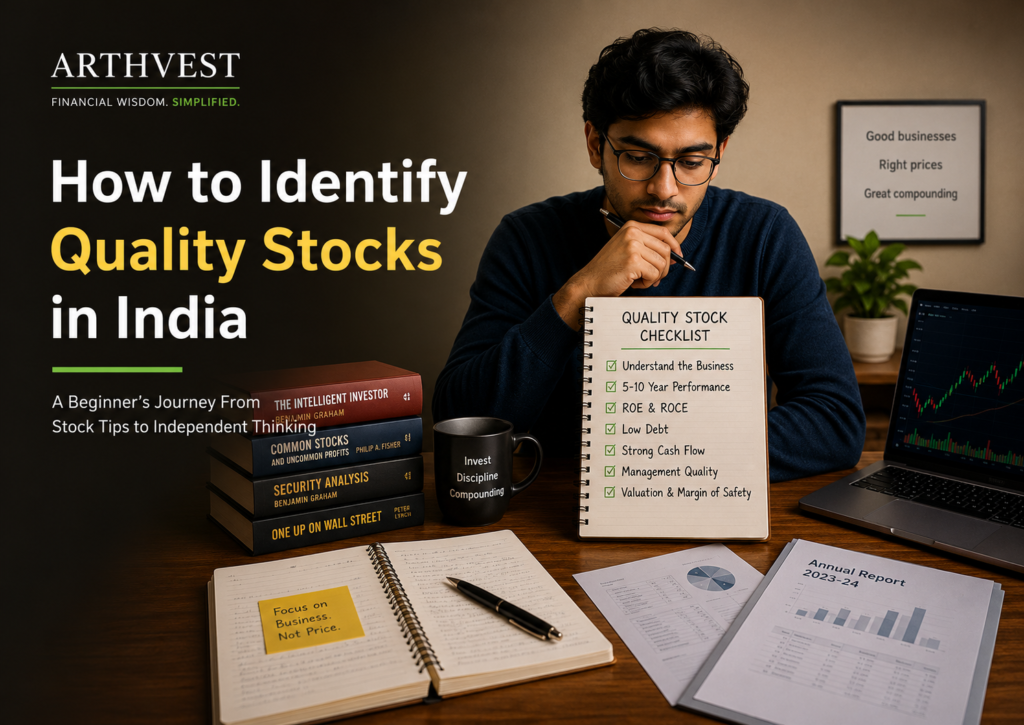
Rahul’s Quality Stock Checklist
On Sunday morning, Rahul opened the same trading app again.
The same stock was still there.
But Rahul was different.
He did not first look at the buy button.
He opened his notebook.
At the top, he wrote:
“Does this business deserve my trust?”
Then he made his checklist.
- Do I understand the business?
- Can I explain how the company makes money?
- Has revenue been consistent over 5-10 years?
- Has profit been consistent over 5-10 years?
- Are margins stable or improving?
- Is ROCE strong and consistent, ideally above 20% for many non-financial companies?
- If it is a bank or NBFC, is ROE healthy and consistent, preferably around 10% or higher?
- Is debt manageable?
- Is interest coverage comfortable?
- Does profit convert into operating cash flow?
- Does management deliver on past promises?
- Are disclosures clear and honest?
- Is promoter pledging low or absent?
- Is the company avoiding careless diversification?
- Is valuation reasonable?
- Do I understand the key risks?
The checklist did not make investing easy.
It made investing honest.
It forced Rahul to slow down. To think. To verify. To admit what he did not know.
And that is exactly what beginners need.
A checklist does not remove risk. It removes laziness from the decision.
Rahul had not become an expert.
But he had stopped being helpless.
The Mistakes Rahul Could Now See
A month earlier, Rahul would have made the usual beginner mistakes without noticing them.
Now he could see them from a distance.
He could see how people buy famous brands without checking valuation.
He could see how “next multibagger” stories turn investing into lottery thinking.
He could see how a Rs 50 stock is not automatically cheaper than a Rs 5,000 stock.
He could see how one ratio can seduce a beginner.
High ROCE? Good, but what about debt?
Low debt? Good, but what about growth?
Strong profit? Good, but what about cash flow?
Famous management? Fine, but did they deliver on past promises?
He could also see how industry cycles fool investors.
Some businesses look wonderful when the cycle is in their favour. Commodity companies, for example, may show strong profits during favourable pricing periods. But when the cycle turns, the same company can look very different.
Rahul realized that beginner investors often search for one perfect signal because one signal feels comfortable.
But real investing is not comfortable that way.
It is a web of questions.
Beginners search for one perfect answer. Investors learn to connect many imperfect clues.
And once Rahul understood that, he wanted to know where to find better clues.
Where Rahul Learned to Look
Rahul used to rely on short videos and app summaries.
Now he still used them, but differently.
They became starting points, not final answers.
He began checking:
- Annual reports
- NSE filings
- BSE filings
- Quarterly results
- Investor presentations
- SEBI disclosures
- Financial data platforms like Screener or Tickertape
At first, annual reports felt intimidating.
Too many pages. Too many tables. Too many formal words.
Meera told him not to read everything at once.
“Start with three places,” she said.
- Management discussion
- Financial statements
- Notes to accounts
Rahul did.
Slowly, the company became less like a stock symbol and more like a living business.
He saw what management was proud of.
He saw what risks they admitted.
He saw debt details.
He saw cash flow.
He saw related-party transactions.
He saw whether old promises matched new results.
He was not dependent on confidence anymore.
He was building his own.
The moment you open an annual report, you stop being only a stock-price watcher. You start becoming a business reader.
That was the real shift.
The Same Stock, a Different Rahul
A few weeks later, Rahul returned to the stock he almost bought.
The company was still famous.
People still called it quality.
The stock still appeared in videos and watchlists.
But Rahul no longer felt the same urgency.
He did not ask, “Will this stock rise?”
He asked:
“Do I understand the business?”
“Has it performed consistently for 5-10 years?”
“Does it use capital well?”
“Is ROCE strong and consistent?”
“If it is a financial company, does ROE make sense with asset quality?”
“Is debt manageable?”
“Does profit become cash?”
“Does management deliver on promises?”
“Is valuation reasonable?”
“Do I understand what can go wrong?”
The market had not become safer.
The future had not become predictable.
But Rahul had changed.
Earlier, he wanted someone to tell him which stock was quality.
Now he wanted evidence.
Earlier, he borrowed conviction from confident people.
Now he knew how to build his own.
That is the beginning of real investing.
Not certainty.
Not excitement.
Not a perfect stock.
Just a better mind asking better questions.
A quality stock is not found by asking, “Which stock will rise?”
It is found by learning to ask:
“Is this business worthy of my trust, and is the price worthy of my money?”
That is where a beginner starts becoming an investor.
Before buying any individual stock, learn how to read a balance sheet and understand basic ratios like ROCE, ROE, debt-to-equity, cash flow, and P/E ratio.
Continue Your Investing Journey
Learning to identify quality stocks is just the first step.
If you're serious about becoming a confident long-term investor, structured learning can save you years of costly mistakes.
Explore our beginner-friendly investing courses designed to help you understand the stock market from first principles.



0 Comments