
Introduction: Why Profit Alone Can Mislead Beginners
Priya first heard the word ROCE on a Sunday morning inside her father’s factory.
Not in a finance class.
Not in an investing course.
Table of Contents
Inside a small manufacturing unit in Pune, where two machines were running side by side.
One machine was old, compact, and slightly noisy. The other was newer, larger, and expensive enough to make Priya nervous just looking at it.
Her father pointed at both machines and asked, “Which one is better?”
Priya looked at the production sheet.
“Both made almost the same profit this month,” she said. “So maybe both are equally good?”
Her father smiled.
“That is how many beginners look at companies.”
Priya frowned. “What is wrong with that?”
He pointed at the older machine.
“This one needed less money to buy, less space, less maintenance, and less working capital. The other one needed far more money to produce almost the same result.”
Priya looked back at the sheet.
Same profit.
Different money required.
Different efficiency.
That was the first crack in her old belief.
Until that morning, Priya thought a good company was simply a company that earned good profit.
Now she had a better question.
How much money did the company need to earn that profit?
Profit tells you what a business earned. ROCE helps you understand how efficiently it earned it.
What Is ROCE? Understanding Capital Efficiency
Priya’s father took a marker and drew two boxes on a cardboard sheet.
Business A uses Rs 10 lakh and earns Rs 2 lakh.
Business B uses Rs 50 lakh and earns Rs 2 lakh.
“Same profit,” he said. “Same quality?”
Priya shook her head.
Business A was clearly using money better.
Only then did her father introduce the term.
ROCE stands for Return on Capital Employed.
It shows how efficiently a company uses the capital employed in the business to generate operating profit.
In simple words, ROCE answers this question:
For every rupee used in the business, how much operating profit does the company generate?
This is why ROCE is useful when studying companies.
A company may show profit, but if it needs too much capital to generate that profit, the business may not be as efficient as it first appears.
A high-quality business usually does not just earn money. It uses money wisely.
ROCE is not just a finance ratio. It is a business-efficiency question.
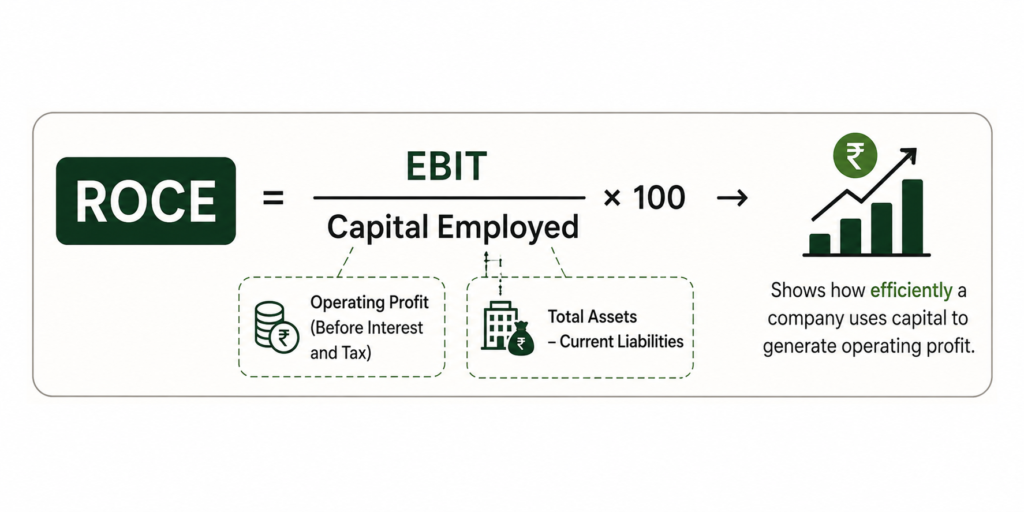
ROCE Formula: How Return on Capital Employed Is Calculated
Priya understood the factory example.
But she still wanted the formula.
Her father wrote:
ROCE = EBIT / Capital Employed x 100
Then he broke it down.
EBIT means Earnings Before Interest and Tax. It is the operating profit of the business before interest and tax.
Capital Employed means the long-term capital used in the business.
A common formula is:
Capital Employed = Total Assets - Current Liabilities
Another common formula is:
Capital Employed = Equity + Non-current Liabilities
Some analysts use average capital employed when capital changes meaningfully during the year.
Priya looked at the formula again.
“So ROCE is not asking only how much profit the company made,” she said. “It is asking how much profit the company made compared with the capital used.”
Her father nodded.
Now the formula felt less like mathematics and more like common sense.
The formula becomes simple when you understand the business question behind it.
ROCE Example: Same Profit, Different Business Quality
Priya opened her notebook and created a simple comparison.
| Company | EBIT | Capital Employed | ROCE |
| Company A | Rs 20 crore | Rs 100 crore | 20% |
| Company B | Rs 20 crore | Rs 200 crore | 10% |
Both companies earn Rs 20 crore before interest and tax.
But Company A uses Rs 100 crore of capital.
Company B uses Rs 200 crore of capital.
Company A generates Rs 20 of operating profit for every Rs 100 of capital employed.
Company B generates Rs 10 of operating profit for every Rs 100 of capital employed.
Priya circled Company A.
“So Company A is more efficient.”
“Yes,” her father said. “From a ROCE point of view.”
Then he added the line that stopped her from turning ROCE into a shortcut.
“But efficient does not automatically mean investable.”
That mattered.
ROCE can help you identify business quality. But it does not replace debt analysis, cash flow, management quality, industry comparison, or valuation.
ROCE helps compare efficiency. It does not make the final investment decision for you.
What Is a Good ROCE for a Company?
Priya’s next question came quickly.
“What ROCE number is good?”
Her father laughed softly.
“That is the question everyone wants answered in one line.”
But business does not work in one line.
For many non-financial companies, investors often consider ROCE above 20%, maintained consistently, as a strong sign of business quality.
But this is only a broad beginner filter.
It is not a universal rule.
A software company may need less capital to grow.
A cement company may need plants, land, machinery, and logistics.
A power company may need large infrastructure.
A retail business may need inventory, stores, and working capital.
Different industries use capital differently.
So Priya wrote a better version of the question:
“Is this ROCE good for this type of business?”
A good ROCE should be judged by:
- Industry standards
- Company history
- Peer comparison
- Debt levels
- Cash flow quality
- Growth stage
- Capital intensity
- Consistency over time
A 20% ROCE for one company may be excellent. For another, it may be normal. For a third, it may be temporarily inflated.
A good ROCE is not just a number. It is a number understood in context.
Why One Year’s ROCE Can Be Misleading
A few days later, Priya found a company with 45% ROCE.
She was excited.
Her father asked, “Was it 45% for one year or many years?”
Priya checked.
This year: 45%
Last year: 17%
Before that: 15%
Before that: 16%
The excitement softened.
One year can mislead.
A company’s ROCE may jump because of:
- One-time profit
- Asset sale
- Temporary demand boom
- Commodity cycle benefit
- Low capital employed base
- Accounting impact
- Unusual cost reduction
- Capital work-in-progress not yet generating revenue
This is why beginners should track ROCE over 5 to 10 years.
A single year is a snapshot.
Five to ten years show behaviour.
Priya began checking whether ROCE was stable, improving, falling, or unusually volatile.
She also checked what happened during weak years.
A quality company does not need perfect ROCE every year. Real businesses face competition, inflation, slowdowns, raw material costs, and regulation.
But if ROCE stays healthy across different conditions, it tells you something important.
The business may have pricing power.
It may control costs well.
It may not need excessive capital to grow.
It may have disciplined management.
One-year ROCE can impress you. Long-term ROCE can educate you.
ROCE vs ROE: What Is the Difference?
Priya later saw another ratio on a stock website.
ROE.
It looked similar to ROCE. So she assumed both meant almost the same thing.
Her father drew two circles.
The smaller circle was labelled shareholder equity.
The larger circle was labelled total capital used in the business.
“ROE looks at the smaller circle,” he said. “ROCE looks at the larger one.”
ROE, or Return on Equity, measures profit generated on shareholders’ equity.
ROCE measures operating profit generated on total capital employed, including equity and debt.
This difference matters because debt can make ROE look attractive.
If a company uses a lot of borrowed money, shareholder equity may be smaller compared with total capital. That can make ROE look strong even when the overall business efficiency is not as impressive.
For many non-financial companies, ROCE can give a broader view because it considers total capital.
But Priya also learned an important exception.
For banks, NBFCs, and financial companies, ROE is often more relevant than ROCE because borrowing and lending are part of the core business model.
For banks and NBFCs, investors also study:
- ROA
- Net interest margin
- NPAs
- Capital adequacy
- Provisioning
- Loan growth quality
- Asset quality
So ROCE and ROE are not enemies.
They answer different questions.
ROCE and ROE are useful only when you know which business you are studying.
Why High ROCE Does Not Always Mean a Good Investment
Priya now felt more confident.
Maybe too confident.
“If a company has high ROCE, should I buy it?”
Her father did not answer directly.
Instead, he asked, “If a machine is excellent but the seller asks double its fair price, will you buy it?”
“No,” Priya said.
“That is valuation.”
A company can be excellent and still be overpriced.
ROCE helps you judge the quality of the business.
It does not tell you whether the stock price is reasonable.
A high-ROCE company can still disappoint investors if the market has already priced in years of perfect growth.
That is why ROCE should be studied along with valuation measures such as:
- P/E ratio
- EV/EBITDA
- Price-to-book ratio
- Free cash flow yield
- Peer comparison
- Historical valuation range
A great business bought at a foolish price can become a poor investment.
ROCE helps you respect the business. Valuation helps you protect your money.
Want to know if a great business is also a great investment?
Learn company valuation step by step in our Value Investigator Course.
When ROCE Can Mislead Beginner Investors
Priya started making a list of high-ROCE companies.
Her father looked at it and asked, “Do you know why each company has high ROCE?”
She did not.
That became the next lesson.
ROCE can mislead when beginners treat it like a ranking table.
A high ROCE may come from genuine business strength.
But it may also come from unusual situations such as:
- One-time profits
- Cyclical boom years
- Asset sales
- Very low capital employed
- Negative working capital models
- Accounting differences
- Recent acquisitions
- Industry-specific accounting quirks
ROCE is also weak when comparing companies from very different industries.
A consumer company and an infrastructure company may both be good businesses, but their capital needs are not the same.
Priya wrote one sentence in her notebook:
“Use ROCE to compare similar businesses, not every business in the market.”
That sentence saved her from many lazy conclusions.
ROCE is a lens, not a verdict.
How to Use ROCE Before Buying a Stock
By now, Priya did not want a shortcut.
She wanted a process.
So her father helped her build a simple ROCE checklist.
Before trusting ROCE, ask:
- What is the company’s current ROCE?
- What was ROCE over the last 5 to 10 years?
- Is ROCE stable, improving, or falling?
- Is the business capital-heavy or asset-light?
- How does ROCE compare with peers?
- Is ROCE supported by operating cash flow?
- Is debt manageable?
- Was ROCE boosted by a one-time event?
- Is the company reinvesting capital at good returns?
- Is valuation reasonable?
Then Priya added her own question:
“Do I understand why ROCE is high?”
Her father smiled.
“That is the best question.”
Because when you understand why ROCE is high, you begin to understand the business itself.
Maybe the company has pricing power.
Maybe it has strong distribution.
Maybe it needs very little capital to grow.
Maybe it has loyal customers.
Maybe it is simply enjoying a temporary cycle.
The number opens the door.
The explanation tells you whether to enter.
The real value of ROCE is not the percentage. It is the investigation the percentage forces you to do.
ROCE Checklist for Beginners
At the end of the week, Priya returned to the first stock she had been studying.
This time, she did not look at the price first.
She opened her checklist.
- Do I understand the business?
- What is the current ROCE?
- What was ROCE over 5 to 10 years?
- Is ROCE consistent?
- Is ROCE better than peers?
- Is the company capital-heavy or asset-light?
- Is ROCE supported by cash flow?
- Is debt under control?
- Is the company reinvesting well?
- Is valuation reasonable?
- Do I understand why ROCE is high or low?
The checklist did not make investing easy.
It made investing more honest.
It forced Priya to slow down before trusting a number.
A checklist does not remove risk. It removes laziness from the decision.
Final Perspective: ROCE Helps You Think Like a Business Owner
A month later, Priya stood again near the same two machines in the factory.
They were still producing output.
They were still making money.
But Priya no longer saw only profit.
She saw capital.
She saw space, maintenance, working capital, debt, efficiency, and reinvestment.
That was the transformation.
The stock market had not become predictable.
Companies had not become risk-free.
But Priya had changed.
Earlier, she asked:
“Which company earns more?”
Now she asked:
“Which company uses capital better?”
Earlier, she saw ROCE as a formula.
Now she saw it as a way to think like a business owner.
That is the real purpose of ROCE.
Not to give beginners false confidence.
But to help them ask better questions.
A beginner asks, “Which stock should I buy?”
An investor asks, “Which business uses capital well, and am I paying a sensible price for it?”
That is what ROCE teaches.
Continue Your Investing Journey
Learning ROCE in stocks is just the first step.
If you're serious about becoming a confident long-term investor, structured learning can save you years of costly mistakes.
Explore our beginner-friendly investing courses designed to help you understand the stock market from first principles.
👉 Explore Arthvest Courses
What is ROCE in simple words?
ROCE shows how efficiently a company uses the capital employed in its business to generate operating profit. It helps investors understand whether a business is using money wisely.
What is the ROCE formula?
The common formula is:
ROCE = EBIT / Capital Employed x 100
Capital employed is commonly calculated as total assets minus current liabilities, or equity plus non-current liabilities.
What is a good ROCE?
There is no universal number. For many non-financial companies, consistently high ROCE, such as 20% or above, can be a positive sign. But it must be compared with industry peers, past performance, debt, cash flow, and valuation.
Is ROCE better than ROE?
For many non-financial companies, ROCE can be more useful because it includes both equity and debt capital. For banks and NBFCs, ROE is often more relevant, along with ROA, NPAs, asset quality, and capital adequacy.
Can high ROCE be misleading?
Yes. High ROCE can be temporarily boosted by one-time profits, asset sales, industry cycles, low capital employed, or accounting effects. Always check 5 to 10 years of ROCE.
Should beginners use ROCE before buying stocks?
Yes, but only as one filter. Beginners should combine ROCE with business understanding, revenue growth, profit consistency, debt, cash flow, management quality, and valuation.



0 Comments