
Disclaimer: This article is for educational purposes only. It is not investment advice, investment research, or a recommendation to buy, sell, or hold Shaily Engineering Plastics or any other stock. Please verify all financial data from official filings and consult a qualified advisor before making investment decisions.
Shaily Engineering Plastics: Why This Company Is More Than a Plastic Manufacturer
At first glance, Shaily Engineering Plastics sounds like a simple plastics company.
That is the easy label.
But the real business is more interesting.
Shaily does not only make ordinary plastic products. It manufactures precision plastic components and devices used by customers in healthcare, consumer products, personal care, lighting, appliances, automotive, and industrial applications.
In simple words, Shaily often works behind the scenes.
The end customer may see a healthcare device, a home product, a personal care package, or an industrial component. But one important part inside that final product may have been manufactured by Shaily.
According to the company’s website, Shaily has been operating for over 35 years, has more than 200 injection-moulding machines, and serves customers across more than 40 countries.
The important shift is this:
Shaily is trying to move from being seen as a plastics manufacturer to being understood as a precision manufacturing company.
That difference matters because precision manufacturing can create higher entry barriers, stronger customer relationships, and better margins than ordinary plastic moulding.
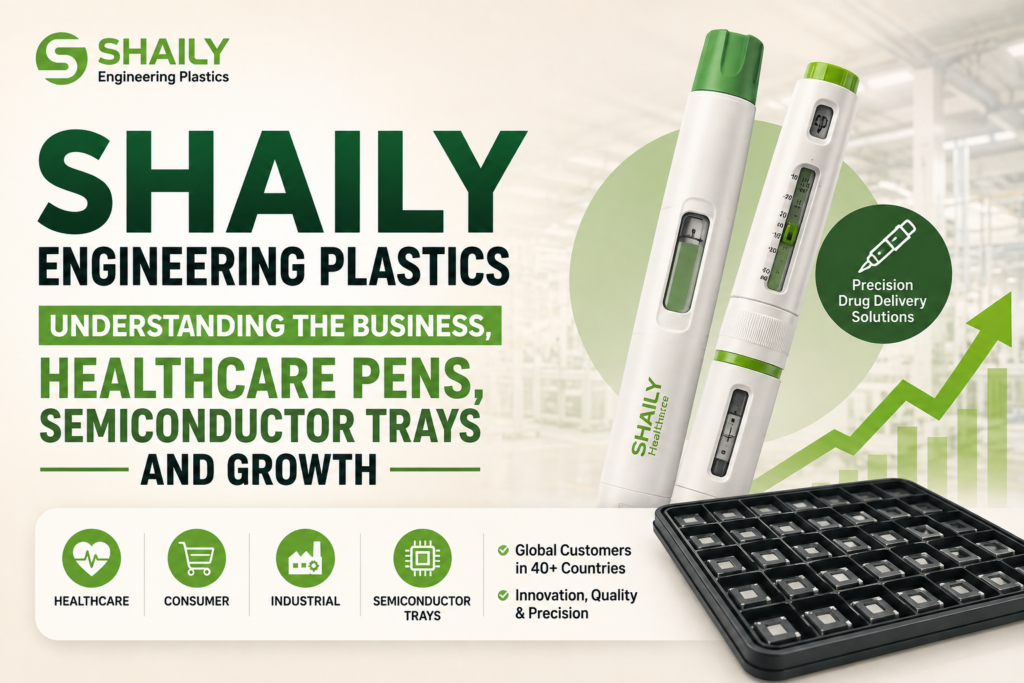
Table of Contents
Shaily Engineering Plastics Business Segments
The company can be understood through four broad business areas:
| Segment | What it Includes | Why It Matters |
| Healthcare | Pen injectors, auto-injectors, drug delivery devices | Fastest-growing and margin-improving segment |
| Consumer and Personal Care | Home furnishing, FMCG, packaging-related products | Older, established business with large customers |
| Industrial, Lighting, Appliances and Automotive | Precision components for industrial and consumer applications | Diversified manufacturing base |
| New Opportunities | Consumer electronics and semiconductor trays | Future growth optionality |
The biggest change in recent years has come from healthcare.
Earlier, Shaily was more dependent on consumer and industrial plastic components. Now, healthcare devices have become a major growth driver.
That is the central story of the company.
Shaily Healthcare Business: What Does the Company Actually Make?
This is the most important section for beginners.
Shaily does not make medicines like semaglutide.
It does not make Ozempic or Wegovy.
It makes the delivery device used to inject medicines.
Think of it like this:
Pharma company: makes or fills the medicine
Shaily: manufactures the precision pen device
Patient: uses the pen to inject the required dose
A pen injector may look simple from the outside, but it is a regulated precision device. It must deliver the correct dose safely, consistently, and reliably.
Shaily’s healthcare portfolio includes pen injectors for insulin, GLP-1 therapies, and other therapies. The company also works on auto-injectors and wearable drug-delivery devices.
So the healthcare opportunity should not be understood as only “Ozempic.”
A better way to say it:
Shaily is building a drug-delivery device manufacturing business, where GLP-1 pens are one major growth driver.
What Are GLP-1 and Semaglutide Pens?
GLP-1 medicines are used in diabetes and obesity treatment. Semaglutide is one of the well-known drugs in this category.
Many of these medicines need to be injected.
But most patients cannot handle complex medical injection systems at home. They need a device that is simple, accurate, and safe.
That is where pen injectors come in.
A pen injector is a device that helps deliver a measured dose of medicine under the skin.
For investors, the key point is:
Shaily is not taking the drug discovery risk. It is participating in the manufacturing supply chain for the device used to deliver the drug.
This is sometimes called a “picks and shovels” type opportunity.
During a gold rush, not everyone mines gold. Some companies sell the tools needed by miners.
In Shaily’s case, the “tool” is the precision delivery device.
But this opportunity also comes with execution and customer-dependency risk, so it should not be treated as guaranteed growth.
Why Healthcare Manufacturing Is Difficult
A normal plastic product can be made with lower regulatory complexity.
A medical device is different.
It needs:
- High precision
- Strict quality control
- Clean-room manufacturing
- Testing and validation
- Regulatory compliance
- Consistent repeatability
- Customer qualification
Shaily’s healthcare facility includes clean-room manufacturing, automated assembly, testing, quality-control laboratories, and metrology capabilities.
The company also refers to healthcare-related certifications and standards such as ISO 13485, ISO 15378, MDSAP, and FDA-related compliance on its official material.
This matters because healthcare manufacturing is not easy to enter overnight.
Customers in healthcare usually need time to qualify suppliers. Devices must work reliably because patient safety is involved.
That can make relationships sticky once a supplier is approved.
But sticky does not mean permanent.
Customers can still change suppliers if quality, cost, delivery, regulatory, or commercial expectations are not met.
Shaily Financial Performance: Consolidated Growth
Based on the financial Results, Shaily’s performance has improved sharply over the last few years.
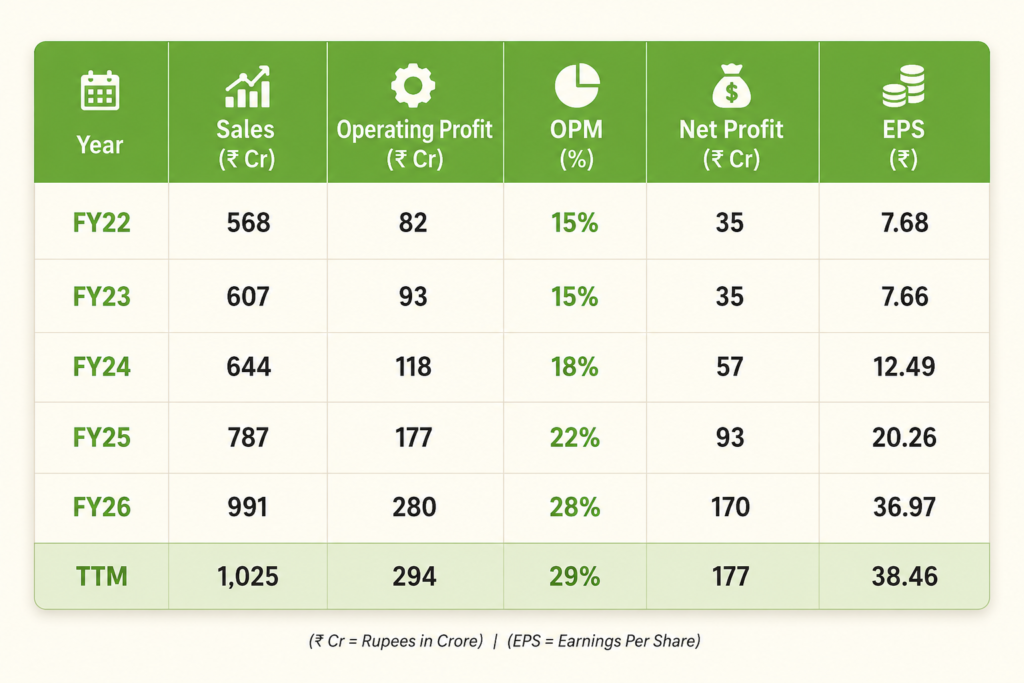
The key point is not only that sales increased.
The bigger story is that profits grew much faster than sales.
Sales increased from Rs. 607 crore in FY23 to Rs. 991 crore in FY26. Net profit increased from Rs. 35 crore to Rs. 170 crore during the same period.
That shows strong margin expansion and operating leverage.
Why Shaily’s Margins Improved
The most important number in the table may be operating margin.
Shaily’s consolidated OPM improved from:
- 15% in FY22
- 15% in FY23
- 18% in FY24
- 22% in FY25
- 28% in FY26
- 29% TTM
This is a major shift.
When margins improve like this, it usually means the business mix is changing, pricing is improving, operations are becoming more efficient, or higher-margin segments are contributing more.
For Shaily, healthcare appears to be an important part of this margin story.
But investors should be careful.
Margins can improve quickly when a high-margin segment grows, but sustaining those margins depends on:
- Capacity utilization
- Product mix
- Customer pricing
- Raw material costs
- Freight costs
- Execution quality
- Competition
- Regulatory approvals
So the right question is not only:
“Did margins improve?”
The better question is:
“Can these margins sustain as the company scales?”
Latest Quarter: Q1 FY27 Performance
The Q1 FY27 consolidated numbers are also strong.
According to Shaily’s Q1 FY27 investor presentation, consolidated revenue was Rs. 280.7 crore, up 14% YoY. EBITDA was Rs. 83.3 crore, up 18% YoY, with EBITDA margin of 29.7%. PAT was Rs. 48.0 crore, up 17% YoY.
The segment movement is even more important:
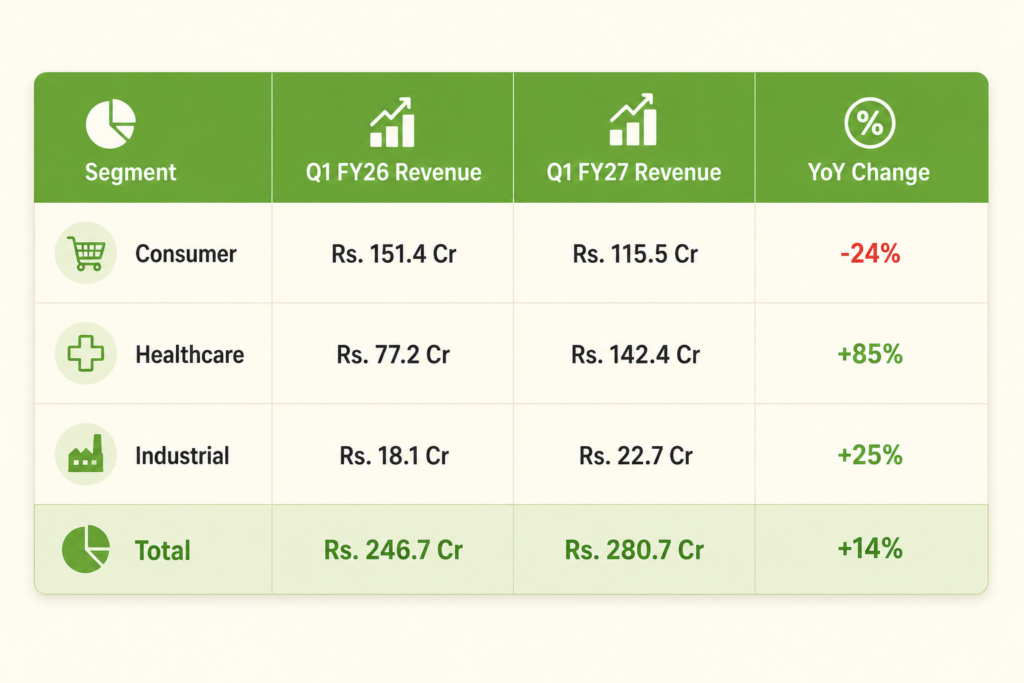
This tells us something important.
Shaily’s growth is not coming equally from every segment.
Healthcare is currently the main engine. Consumer is under pressure. Industrial is growing, but from a smaller base.
That makes healthcare execution very important for the next phase.
Healthcare Growth: The Main Engine
Healthcare revenue has grown sharply.
Based on the company’s FY26 investor communication reported publicly, healthcare revenue increased from around Rs. 165 crore in FY25 to around Rs. 393 crore in FY26, a growth of about 139% YoY.
In Q1 FY27, healthcare revenue grew 85% YoY to Rs. 142.4 crore.
This is why the market has started looking at Shaily differently.
The company is no longer just a supplier of plastic components for consumer products. It is increasingly being evaluated as a healthcare-device manufacturing company.
But this also creates a new risk.
When one segment becomes the main growth driver, investors must track whether that segment can keep growing without execution problems.
Shaily Pen Injector Guidance and Capacity Expansion
Management commentary around pen injectors is one of the most important things to track.
Publicly available Q1 FY27 earnings-call summaries and the company’s investor material indicate:
- Shaily discussed FY27 device volume guidance of around 36 million pens
- Management indicated confidence in going beyond this guidance, subject to demand and partner-related factors
- Additional pen capacity is expected to become operational, taking total installed pen injector capacity to around 75 million pens per annum
- The company has also discussed healthcare expansion through Abu Dhabi
This sounds exciting, but investors should separate capacity from revenue.
Capacity means the company can manufacture a certain number of devices if everything works well.
Revenue depends on:
- Customer orders
- Regulatory approvals
- Utilization
- Timely ramp-up
- Supply-chain stability
- Quality and delivery performance
A factory with capacity is not the same as a factory running at full utilization.
That is why future quarterly updates matter.
Shaily Semiconductor Tray Business Explained
Shaily’s semiconductor opportunity is early-stage but interesting.
The company is entering semiconductor trays.
But it is not making semiconductor chips.
A semiconductor tray is used to hold, protect, and move semiconductor components during manufacturing, testing, and handling.
A simple analogy is an egg tray.
The tray does not make the eggs. It protects them.
A semiconductor tray does something similar for chips, but with much higher technical requirements.
These trays may need:
- Anti-static or conductive material
- Very precise dimensions
- Compatibility with automated handling
- High consistency
- Low defect rates
This connects well with Shaily’s existing precision-plastics capability.
Why Semiconductor Trays Could Matter
India is trying to build a semiconductor manufacturing ecosystem.
If semiconductor fabs, assembly, and testing facilities scale in India, they will need many supporting components and consumables.
Semiconductor trays are one small but necessary part of that supply chain.
Shaily has signed an agreement with a Korean company to manufacture and supply these trays in India, according to publicly available earnings-call summaries.
Management commentary suggests semiconductor revenue is expected to begin around Q4 FY27, with an initial investment of about Rs. 5 crore in an existing facility.
But this should be treated carefully.
Semiconductor trays are not expected to be a major FY27 revenue contributor. This is more of a 3-5 year optionality linked to India’s semiconductor ecosystem.
Consumer Electronics and Abu Dhabi: Other Growth Levers
Shaily is also entering consumer electronics.
Management has indicated that commercial supplies have started with a consumer-electronics customer. The work is described as technically demanding, which may create entry barriers if execution is successful.
The Abu Dhabi facility is another important future project.
Management has discussed an investment of around AED 130-150 million and annual planned capacity of around 75 million pen and auto-injector devices, with operations targeted around the end of FY28.
Again, the correct investor approach is to track execution.
Announcements matter less than actual revenue, margins, customer orders, and utilization.
Shaily Clients and Customer Concentration Risk
Shaily displays several customer names on its official website.
In healthcare, the company’s website includes names such as Sanofi, Teva, Glenmark, Zydus, Dr. Reddy’s Laboratories, Lupin, Aurobindo Pharma, Natco Pharma, Alembic Pharmaceuticals, Sun Pharma, Wockhardt, Alvogen, Recipharm, Orbicular, and CinnaGen.
In other areas, Shaily’s website and materials show names across personal care, appliances, automotive, and industrial applications.
Healthcare - https://shaily.com/healthcare
Personal Care - https://shaily.com/personal-care
Lighting-apliances-automotive - https://shaily.com/lighting-appliances-automotive
These names show the quality of the customer base.
But there is a very important limitation.
A logo on the website does not tell us how much revenue comes from that customer.
Shaily does not publicly disclose a complete current customer-wise revenue breakdown.
Historically, customer concentration has been an important risk for the company. The pasted research suggests one large customer and top five customers have contributed a significant share of revenue in earlier periods.
For the article, this should be treated as a risk to track, not as a current exact client-wise revenue claim unless verified from official filings.
Shaily Share Price Growth: What Investors Should Understand
The stock price has already rewarded investors strongly.
- 10 years: 41%
- 5 years: 56%
- 3 years: 115%
- 1 year: 53%
This is a powerful stock-price performance.
But strong past returns create a different question.
Has the market already priced in a lot of future growth?
This is important because a company can be good and still become risky if expectations are too high.
Stock price growth should not be read as proof that future returns will continue.
It should be read as a signal that investors are already expecting strong execution from healthcare, pen injectors, new capacity, semiconductor trays, consumer electronics, and global expansion.
The business may still do well. But after such a large rally, disappointment risk becomes higher if execution slows.
Valuation Risk: Strong Business Does Not Always Mean Attractive Stock
This is one of the most important investor lessons.
A company can have:
- Strong revenue growth
- Rising margins
- Healthcare optionality
- Good customers
- New capacity
- Exciting future opportunities
And still be expensive.
Valuation matters because investors do not buy only the business. They buy the business at a price.
If the price already assumes perfect execution, even a small delay can affect returns.
For Shaily, valuation risk should be watched along with:
- P/E ratio
- P/B ratio
- Market capitalization vs profit
- Free cash flow
- Capex requirements
- Execution timeline
- Margin sustainability
- Customer concentration
The right question is not:
“Is Shaily a good company?”
The better question is:
“At the current price, how much future success is already expected?”
What Makes Shaily Different?
Shaily is interesting because several capabilities come together.
- Precision plastics experience
The company is not only moulding simple products. It works in precision manufacturing. - Healthcare device capability
Drug-delivery devices require quality systems, testing, and customer qualification. - Export customer base
The company serves customers across multiple countries. - Business mix improvement
Healthcare growth has improved the margin profile. - New optionalities
Consumer electronics, semiconductor trays, and Abu Dhabi can become future growth levers. - Long operating history
The company has been operating for decades, which matters in manufacturing relationships.
But none of these removes risk.
They only explain why the business deserves attention.
Key Risks Investors Should Track
1. Customer Concentration
If a large customer reduces orders, delays purchases, or changes sourcing strategy, revenue can be affected.
This is especially important because the consumer business has already shown pressure.
2. Healthcare Execution Risk
Healthcare is now a major growth driver. Any delay in customer approvals, device qualification, regulatory processes, or production ramp-up can affect growth.
3. Margin Sustainability
Operating margin has improved sharply. Investors should track whether these margins can sustain as volumes scale and input costs move.
4. Capex and Free Cash Flow Risk
Expansion requires capital. If capex rises faster than cash generation, free cash flow may remain under pressure.
5. Semiconductor Timing Risk
Semiconductor trays are an early opportunity. If India’s semiconductor ecosystem scales slowly, revenue from this business may also take time.
6. Valuation Risk
After strong stock-price performance, expectations may already be high. Any disappointment can affect the stock.
What To Watch in Coming Quarters
Investors should track:
- Healthcare revenue growth
- Pen injector volume delivery
- Capacity utilization
- Operating margin sustainability
- Consumer segment recovery
- Semiconductor tray commercialization
- Consumer electronics revenue contribution
- Abu Dhabi project progress
- Customer concentration trends
- Debt and free cash flow
- Management guidance vs actual delivery
These indicators will show whether Shaily is executing the story or only talking about it.
Arthvest View: The Big Picture
Shaily Engineering Plastics is no longer easy to understand with one label.
Calling it a plastic company is too shallow.
A better description is:
Shaily is a precision manufacturing company moving deeper into healthcare drug-delivery devices, while building future optionality in semiconductor trays and consumer electronics.
The financials show strong improvement.
Consolidated sales increased from Rs. 607 crore in FY23 to Rs. 991 crore in FY26. Net profit increased from Rs. 35 crore to Rs. 170 crore. Operating margin improved from 15% to 28%.
That is the positive side.
The caution is equally important.
The stock has already delivered very strong returns. Healthcare execution has become crucial. Customer concentration remains a risk. Semiconductor trays are still early. New capacity must be utilized. Margins must sustain.
So the cleanest way to think about Shaily is this:
It is a business with strong transformation potential, but also high execution expectations.
For a beginner investor, the lesson is not “buy” or “avoid.”
The lesson is to understand what actually drives the business.
If healthcare pens scale, margins sustain, customers diversify, and new businesses commercialize, Shaily’s business story can remain strong.
If execution disappoints, valuation and expectations can become uncomfortable.
That is the real investor work:
Not getting excited by the story alone.
Understanding what must happen for the story to become numbers.
Want to learn how to analyse businesses like this? Explore our [Fundamental Analysis Course] to understand financial statements, ratios, valuation, and business quality step by step.
Important Disclaimer
This article is for educational and informational purposes only.
It is intended to explain Shaily Engineering Plastics, its business model, financial performance, management commentary, opportunities, and risks in simple language.
It is not investment advice, investment research, or a recommendation to buy, sell, or hold Shaily Engineering Plastics or any other security.
Financial figures should be independently verified from the company’s official filings, annual reports, investor presentations, and exchange disclosures.
Past financial performance and past share-price performance do not guarantee future results.
Management guidance, capacity plans, customer opportunities, semiconductor timelines, and other forward-looking statements are subject to uncertainty.




0 Comments